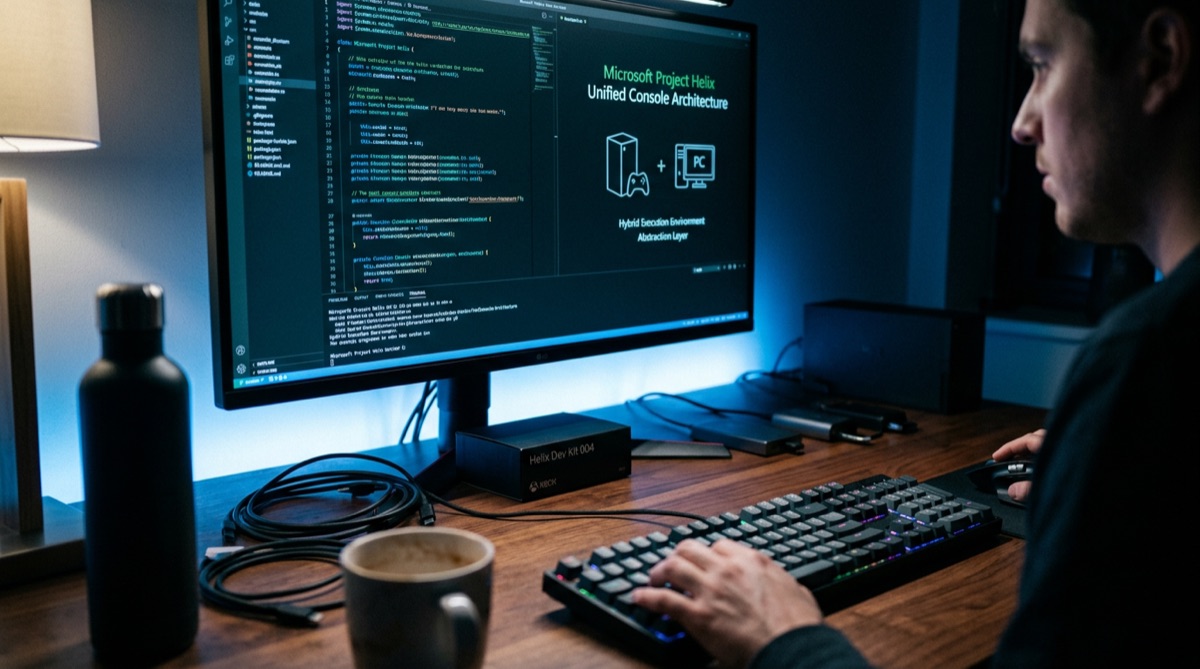
The speculation is over. Microsoft's next-gen console, officially codenamed 'Project Helix' as of this morning, is confirmed to be a hybrid machine designed to play both Xbox and PC games. New Xbox CEO Asha Sharma's announcement confirms long-standing rumors but raises immediate questions about abstraction cost and failure modes. The statement comes from Asha Sharma, who took over as CEO of Microsoft Gaming just two weeks ago following the surprise retirement of Phil Spencer and resignation of Sarah Bond.
Microsoft is dusting off an old codename here; 'Project Helix' was first used back in 2016 for their initial, less ambitious strategy to converge Xbox and Windows gaming. Reusing the name suggests this is the ultimate realization of a decade-long, and often troubled, strategic goal. The rumor is an AMD system-on-chip (SoC) that mashes up Xbox hardware with PC architecture. This reliance on a single, unified chip creates a critical vulnerability, as any flaw within it could cripple the entire system.
The upside of accessing PC storefronts like Steam is offset by the driver conflicts, update problems, and software bloat inherent in the Windows ecosystem. We already have a real-world test case for these problems: Valve's Steam Deck. While impressive, its Proton compatibility layer is a constant work-in-progress, and navigating desktop mode to troubleshoot non-Steam applications with a controller is precisely the kind of friction console users despise. Will users be forced to pay for Xbox Game Pass even for PC games they already own?
The monoculture problem is real. Consolidating both Xbox and PC gaming onto a single platform dramatically increases the potential impact of security breaches. Imagine a zero-day in the Windows kernel. Suddenly, both Xbox and PC games are compromised. That's a huge step backward from previous consoles, where exploits were mostly isolated. For example, the WannaCry ransomware attack exploited a vulnerability in Windows to infect hundreds of thousands of computers worldwide; a similar vulnerability in Project Helix could affect both PC and console users simultaneously.
Here's how a failure could look:
mermaid
sequenceDiagram
  participant User
  participant Xbox_Helix
  participant Windows_Kernel
  participant Game_Storefront
  User->>Xbox_Helix: 1. Launch Game (via Steam)
  Xbox_Helix->>Windows_Kernel: 2. System Call (Graphics, Input)
  Windows_Kernel-->>Xbox_Helix: 3. Response (Vulnerable Code)
  Xbox_Helix->>Game_Storefront: 4. Game Executes (Compromised)
The "Because We Can" Fallacy: just because you *can* run Xbox and PC games on the same hardware doesn't mean it's a good idea. The potential benefits of running Xbox and PC games on the same hardware might not outweigh the risks of increased security vulnerabilities and compatibility issues.
An incremental hardware release model, like Apple's, is another worry. Faster hardware is generally good, but it also risks splitting the user base and causing compatibility nightmares. Games optimized for the "Helix+" might run with significantly reduced framerates or graphical glitches on older versions, forcing users to constantly upgrade. This contrasts sharply with the traditional console model, which provided a stable hardware base for many years, ensuring consistent game compatibility throughout its lifecycle. This situation could lead to a fragmented gaming experience, similar to the early days of PC gaming, where frequent hardware upgrades were often necessary to maintain performance with the latest titles.
Online chatter is mixed. Some are hyped, others are deeply skeptical. Price, performance, and user experience are all big unknowns. The promise of forward and backward compatibility across current and legacy Windows versions and different Xbox models sounds great, but the technical challenges are huge. Think about maintaining driver compatibility across a sprawling matrix of hardware and OS builds.
My 2027 prediction: Microsoft will struggle to balance performance, compatibility, and user experience. Given the company's history with ambitious hardware plays like Surface RT or the early days of Windows on ARM, a messy launch plagued by driver issues isn't just a risk, it's a probability. The abstraction layer required to run non-native PC titles will introduce significant overhead—I'd estimate a 20-30% performance penalty out of the gate, making a consistent 60fps at 4K a pipe dream for demanding titles not built for the Helix architecture. Failure will result in a fragmented ecosystem where games are not optimized for all hardware configurations, leading to inconsistent performance and user dissatisfaction. Success will require a complete overhaul of Microsoft's software update strategy, prioritizing stability and security over rapid feature deployment.
Server room, representing the infrastructure needed to support