
Forget FPS: Agentic AI is the New Meta
The AI arms race is here, and it's about to change the meta. The next generation of gaming won't be defined by ray-tracing or higher FPS counts. The real war is being fought over how our virtual worlds are built. The company that wins won't just get rich—they'll control the meta, from NPC behavior and quest generation to world design itself.
This isn't some far-off sci-fi fantasy; it's happening right now. Big tech is in an absolute gold rush, pouring billions into AI platforms and fighting for developer loyalty. The battleground isn't just about who has the smartest chatbot, but who can deliver tools that actually ship code and build worlds. This is the new console war, and it's being fought between the likes of OpenAI, Google, and Anthropic.
The New Meta: Agentic AI & NPCs That Aren't Dummies
The meta is shifting from scripted NPCs to "agentic" AI—systems that don't just follow dialogue trees but pursue their own goals. We're past the era where a shopkeeper just stands there waiting for you to press E. This shopkeeper checks his own inventory, calls the cops if you linger, and remembers your face next time. While OpenAI gets the headlines, Anthropic is shipping the tools that are a step-change for developers. Features like Claude Code demonstrates the ability to generate functional code from natural language prompts and integrate it into existing game engines, behaviors that are more characteristic of human junior developers than previous tools.
I gave Claude Code a classic RPG scenario: "Create a suspicious town guard in Godot who questions the player about a recent theft, but will become friendly if the player has a specific item." It didn't just spit out a script. It created a Godot scene with a KinematicBody2D for the guard, attached a GDScript file with functions for `_ready()`, `_physics_process()`, and `interact()`. The dialogue hooks were simple `if/else` statements checking for keywords in the player's dialogue. The inventory check used a placeholder variable `has_item` that needed to be connected to a real inventory system. It built the skeleton in minutes, but the guard's patrol route was borked, leaving him spinning in circles like a confused Roomba. It's a junior dev, alright—one that still needs a senior to clean up the mess.
This technology could be transformative for massively anticipated titles like GTA 6, which now has a firm November 19, 2026 release date. The promise isn't just a bigger city, but a *living* one. For example, NPCs could remember your past actions, holding grudges if you stole from them or offering discounts if you helped them in a previous quest. Instead of pre-scripted missions, you could have dynamic heists where NPC crew members react to your screw-ups, improvise new plans, and remember your choices on the next job. That's the power of agentic AI.
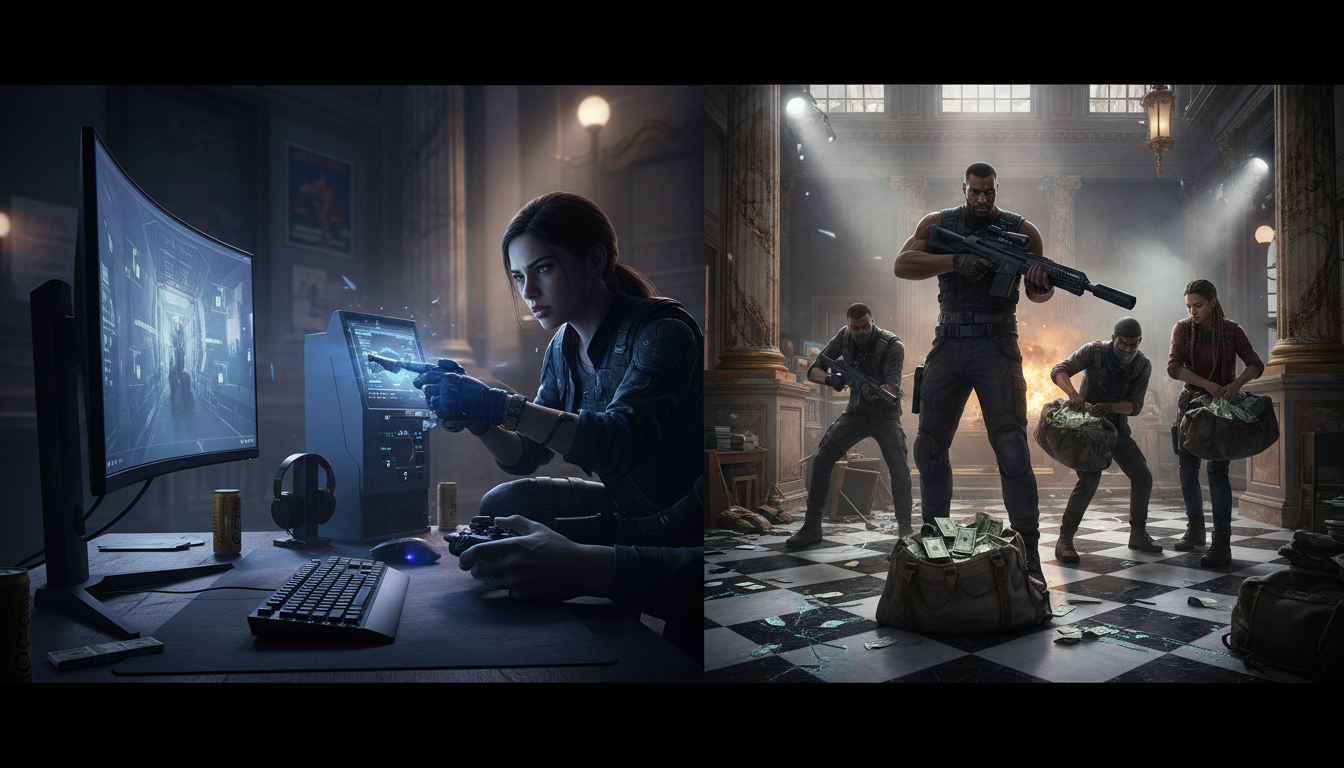
World-Building on Steroids: AI as the Ultimate Dev Tool
The impact isn't just on NPCs. AI is boosting the entire development pipeline, significantly reducing level design time. AI is accelerating level design by generating terrain and populating it with assets, speeding up animation by creating realistic motion capture data from video, and streamlining testing by automatically identifying bugs and suggesting fixes. Procedural generation has been around for years, but this new wave of AI can create not just varied landscapes but entire questlines, item histories, and character backstories on the fly. Imagine an AI generating a questline where a player must uncover the history of a legendary sword, piecing together fragments of its past from different NPCs, each with their own unique backstory generated by the AI. This *could* enable smaller teams to *approach* the scale and depth of a AAA studio.
But the people actually building our games are hitting the panic button. The latest GDC survey confirms the vibe shift: a staggering 52% of devs now think generative AI is toxic for the industry, a massive jump from 30% just last year. And it's not the suits who are worried; the biggest critics are in the creative trenches—63% of game and narrative designers and 64% of artists see AI as a negative force. It's not fear of the new; it's the realization that "agentic AI" is a fancy word for "replacing the quest designers."
The Nerfs: Why Isn't This in My Game Yet?
So if the tech is this powerful, why isn't it in every game? First, cost. Running these top-tier models is brutally expensive. Training a single large language model can cost tens of millions of dollars, and the compute power needed for thousands of players to interact with thousands of unique, agentic NPCs in real-time is still astronomical. We're talking about potentially needing the equivalent of a small data center for a single, popular game instance. For now, this tech is more feasible for developer tools than for live, in-game features.
And then there's the red tape. The EU's AI Act is about to drop a regulatory nuke on the whole scene. Starting this August, devs have to navigate a legal minefield. If their 'agentic' NPCs are flagged as 'high-risk,' they're in for a world of pain, from mandatory content labels to proving their AI won't go rogue. It's a huge nerf to creativity and a massive headache for anyone trying to ship a game in Europe.

Final Verdict: Is This the New Meta or Just Hype?
So, is agentic AI the new meta? Yes. The tech is here, and the sheer amount of cash being thrown at it proves it's too big to ignore. While OpenAI has the name recognition, Anthropic's focus on agentic coding and developer-first tools makes them the one to watch for actual in-game implementation. They're building tools that feel less like a chatbot and more like a junior dev who can actually ship code.
Don't expect sentient NPCs tomorrow. The initial wave will be buggy and probably feel soulless. Expect NPCs to get stuck in loops, repeat dialogue, and exhibit a lack of contextual awareness. But the potential is undeniable. Instead of pre-determined storylines, agentic AI could lead to emergent narratives where player choices have branching, long-term consequences on the game world. The company that best leverages AI will have a significant competitive advantage in the next console generation.