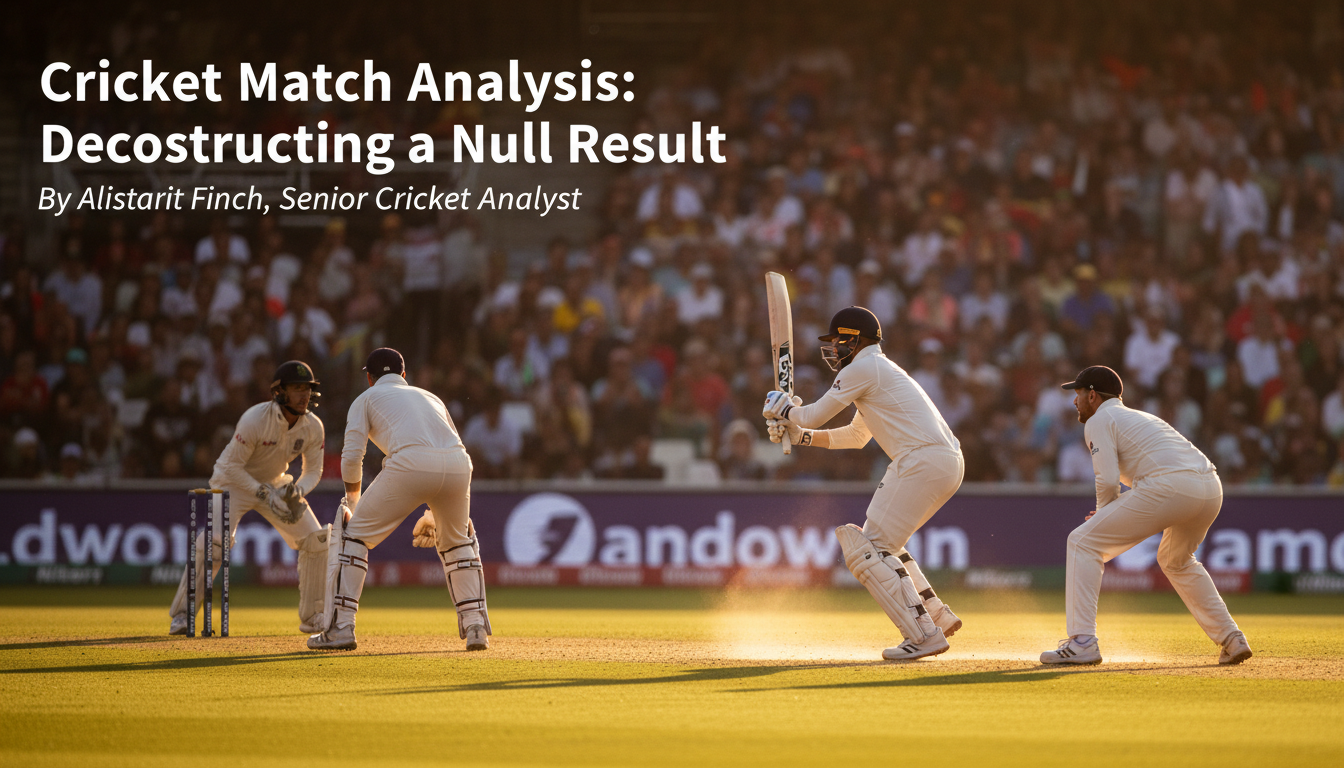
Some cricket matches burn themselves into history; others simply vanish into the ether. We are drawn to the glorious uncertainty of a final-ball thriller, the narrative of a heroic comeback, or the sheer dominance of a record-shattering performance. But what of the match that offers none of these things? What of the null result?
Consider the Super Four clash between Sri Lanka and Pakistan at the 2022 Asia Cup. Played on September 9th in Dubai, it was a contest devoid of consequence. Both teams, having already dispatched India and Afghanistan, were assured of their places in the final two days later. The match became a blank canvas, a dress rehearsal played at half-speed, inviting us to ask a deeper question: what is a contest worth when nothing is on the line?

A Dress Rehearsal in the Desert
The game unfolded not in a bubble, but against a backdrop of global news that dwarfed its significance. The world’s attention was fixed on Balmoral, where the longest reign in British history had concluded just the day before. On the field, the lack of stakes was palpable. Pakistan, batting first, were bundled out for a paltry 121. Their captain, Babar Azam, in the midst of a wretched run of form, contributed a brief 30 from 29 balls—an innings that did little to halt his poor run of form in the tournament. It was the innings of a man going through the motions.
This was not the high-octane rivalry we expect. It was a sparring session. The usual fire of a Pakistan-Sri Lanka encounter was missing, replaced by a strange and hollow procedural. The contest felt less like a prelude to a final and more like an optional net session, played out under the glare of stadium lights.
The Hasaranga Paradox
Yet, even on a blank canvas, an artist can leave a mark. In a match defined by collective apathy, Wanindu Hasaranga produced a spell of profound quality. His figures of 3 for 21 in four overs were a masterclass in leg-spin bowling, a flash of brilliance in the gloom. He was named Player of the Match, an award that felt both entirely deserved and strangely disconnected from the game's empty context.
Herein lies the paradox. Hasaranga, who would be named Player of the Tournament for his heroics, was magnificent. He bamboozled batsmen with his googly, a masterclass in deception. But this performance exists in a vacuum. It was a sublime individual effort untethered from consequence, a glorious verse written in a notebook that was then promptly closed and forgotten. It neither won a tournament nor prevented elimination; it simply was.

The Echo in an Empty Room
The story of this nullity is told not by what is missing, but by what is present: the basic scorecard. It is our most fundamental data set, and here, it paints a picture of profound indifference. Pakistan’s 121 all out in 19.1 overs speaks not of a dramatic collapse, but of a slow fade. Sri Lanka’s chase, reaching 124 for 5 with three overs to spare, was neither a canter nor a struggle. It was simply a task completed.
There were no declarations of intent, no tactical masterstrokes forced by pressure. The run rates were pedestrian, the fielding lacked its usual desperate intensity. The data tells us a game of cricket occurred, but it cannot show us a contest that truly mattered. This match serves as a stark reminder: context is everything. Without the animating force of consequence, the glorious uncertainty of cricket gives way to a predictable and forgettable certainty. The absence of a story, in this case, *is* the story.